Headlight restoration at Invisible Touch Inc. removes yellowing, oxidation, and cloudiness from plastic headlight lenses – restoring optical clarity, improving night time visibility, and protecting the lens surface with a fresh UV coating that prevents rapid re-oxidation. We serve Bedford, MA, and the greater Boston metro area.

200+ Happy Customers
in Bedford, MA
Modern headlight lenses are made from polycarbonate plastic, which is lightweight and impact-resistant but degrades under UV radiation exposure over time. Factory headlights include a thin UV-protective coating applied at the lens surface — but this coating breaks down after 5–8 years of sun exposure, leaving the bare polycarbonate unprotected. Without UV protection, the polycarbonate oxidizes and turns yellow, hazy, and opaque.
In Massachusetts, the combination of intense summer sun, temperature extremes, and road salt exposure accelerates this process. Most vehicles with 8–12 years of New England road use show noticeable headlight yellowing. The problem is cosmetic initially — but as oxidation progresses, it measurably reduces the light output through the lens. Severely oxidized headlights can transmit as little as 20% of their original light output, significantly reducing nighttime visibility and increasing stopping distance at speed. In Massachusetts, headlights that fail to produce adequate illumination can also fail the annual state safety inspection — making restoration a compliance issue, not just a cosmetic one.
The correct solution is not simply polishing the lens - it is polishing the lens and applying a fresh UV-protective coating. DIY headlight restoration kits that omit the UV coating step produce results that revert to yellow within 6–12 months because the polycarbonate is still unprotected from UV after polishing.

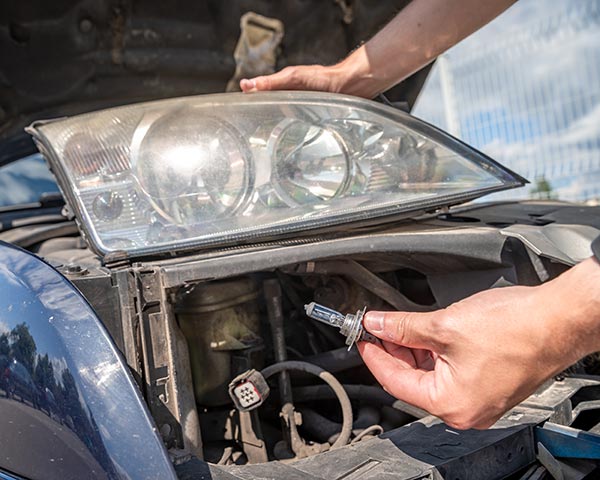
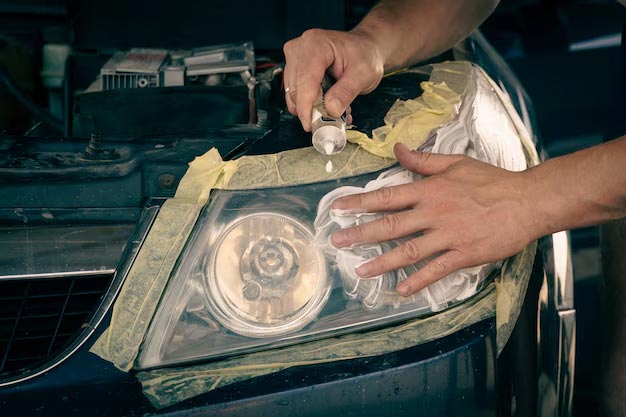
Each headlight is inspected for internal damage, seal integrity, and oxidation severity before any work begins. The surrounding paint and bodywork are masked to protect adjacent surfaces during the sanding and polishing stages.

The oxidized outer layer is removed through a progressive wet sanding sequence - starting with a coarser grit to remove the damaged surface layer, then stepping through finer grits to restore optical smoothness. This process exposes fresh, clear polycarbonate beneath the oxidation.

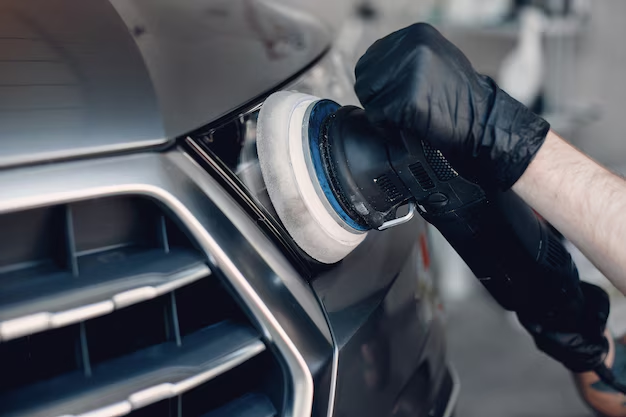
After sanding, the lens is machine-polished to restore full optical clarity. The polishing compound removes micro-scratches left by the final sanding stage, producing a lens surface that is smooth and transparent.

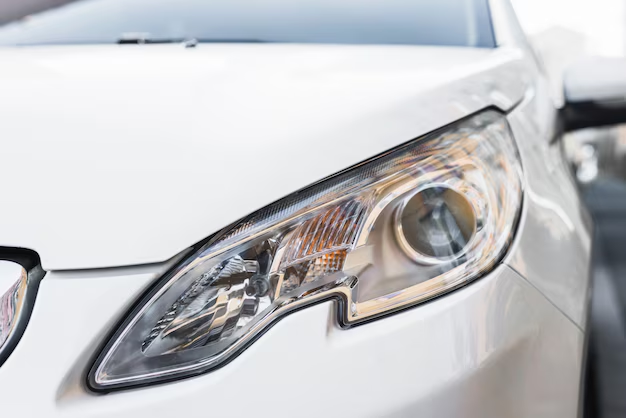
A professional-grade UV-protective coating is applied to the restored lens surface. This coating is the critical step that prevents re-oxidation - without it, the polished polycarbonate begins degrading again immediately. With it, the lens remains clear for 2–4 years under normal New England exposure conditions.
Rim refinishing costs $150–$300 per wheel for a standard alloy in a single-color finish, and $200–$400 per wheel for custom colors, two-tone finishes, or wheels requiring significant substrate repair before refinishing. A full set of four wheels refinished together is priced at a per-wheel discount — typically $500–$1,000 for a set in a standard finish. Chrome refinishing or de-chroming is priced higher due to additional stripping and preparation requirements. We provide written estimates after inspecting each wheel.
A single wheel takes 1–2 days. A full set of four wheels typically takes 3–5 business days to allow for complete stripping, preparation, finish application, and cure time between stages. We do not rush the cure cycle — finish applied over an incompletely cured primer or base coat fails faster and peels at wheel edges under heat cycling. We provide a timeline at booking and call when the wheels are ready.
Both produce durable, quality results — the right choice depends on the finish type and intended use. Powder coat is applied electrostatically as a dry powder and cured in an oven — it produces an extremely hard, chip-resistant finish and is excellent for solid colors, particularly gloss and satin black. Liquid paint gives more flexibility in color matching, metallic finishes, multi-stage effects, and color combinations that powder coat cannot achieve. For factory color matching and complex finishes, liquid paint is the correct system. For maximum durability in a solid color, powder coat is a strong choice. We advise on the correct system during consultation.
Yes - wheel condition is one of the first visual assessments a buyer makes, and damaged or corroded wheels lower perceived vehicle value disproportionate to their actual repair cost. Refinishing a set of wheels for $600–$900 can improve appraisal or private sale price by $1,000–$2,000 on a well-maintained vehicle where the wheels are the primary visual detractor. We recommend refinishing before sale if the wheels have visible corrosion, peeling finish, or heavy curb rash.
Most alloy and steel wheels with cosmetic damage can be refinished, but wheels with structural damage must be repaired before refinishing - or replaced if the damage is beyond repair. Cracks through the barrel or spoke, severe bends that have deformed the mounting surface, and wheels that have lost material from repeated curb impacts may not be refinishing candidates. We assess every wheel before quoting and will recommend wheel repair for structural issues or replacement if the wheel cannot be safely restored. Machined and diamond-cut wheels can be refinished, but require lathe re-cutting rather than conventional painting - we confirm the correct process during assessment.
Contact Invisible Touch Inc. for a free wheel assessment and refinishing quote. We’ll inspect each wheel, confirm the correct finish system, and provide a written estimate before any work begins.