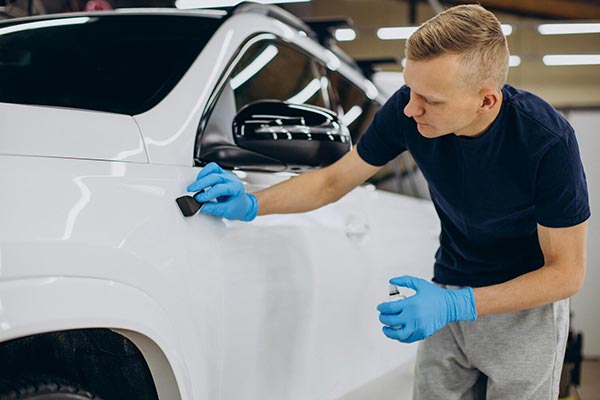
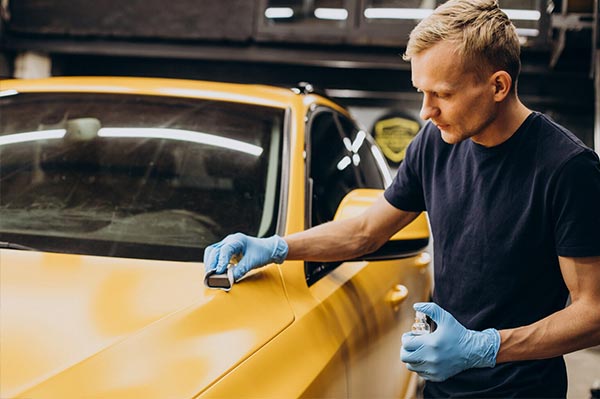
Paintless dent repair (PDR) is a technique that removes dents from a vehicle’s body panels by massaging the metal back to its original shape from behind the panel using specialized tools — without sanding, filling, priming, or repainting the surface. The paint remains completely undisturbed throughout the process.
PDR works because automotive sheet metal is flexible enough to be reshaped when pressure is applied gradually and precisely from the reverse side of the panel. The technique preserves the vehicle’s original factory paint finish, which is both the strongest and most color-accurate paint the vehicle will ever have.

200+ Happy Customers
in Bedford, MA

Paintless dent repair uses metal rods and picks inserted behind the panel through access points — holes, window channels, or door openings - to reach the back of the dented area. The technician applies controlled upward pressure at specific points on the dent while observing the panel surface under specialized reflection lighting that makes the dent’s exact shape and depth visible.
The process works in graduated stages: the technician moves the metal incrementally from the perimeter of the dent inward, gradually reducing the dent profile until the surface is flat. On dents with limited behind-panel access — some roof panels or areas near frame welds — a glue-pull technique applies controlled outward force from the paint surface using a low-temperature adhesive system that releases without damaging the paint.
The result is a panel that returns to its original profile with no filler, no primer, and no color matching - the factory paint surface is intact from edge to edge.

PDR repairs dents where the paint surface is intact, and the metal has not been permanently stretched or sharply creased. Common PDR candidates include:

Paintless dent repair is not the right repair for every dent. PDR cannot fix:
A qualified PDR technician assesses each dent before committing to PDR as the repair method. Attempting PDR on an ineligible dent produces a worse result than traditional repair. When PDR is not viable, Invisible Touch Inc. performs traditional dent repair using automotive-grade body filler and factory color-matched paint.
|
|
PDR |
Traditional Repair |
|
Paint touched |
No |
Yes — sanded, primed, repainted |
|
Filler used |
No |
Yes |
|
Original paint preserved |
Yes |
No |
|
Time |
1–4 hours per dent |
1–3 days |
|
Cost |
Lower |
Higher |
|
Best for |
Paint-intact dents |
Dents with paint damage, creases |
PDR costs $75–$150 per standard door ding and $150–$300 for larger or more complex dents. Hail damage affecting multiple panels is quoted per vehicle based on dent count — most hail repair jobs are $400–$1,200 depending on severity.
Most single dent PDR repairs are completed in 1–3 hours. Hail damage repairs take 1–2 days. PDR is significantly faster than traditional repair because there is no paint cure time.

Yes - correctly performed PDR is permanent. The metal is physically reshaped to its original position. There is no filler or surface treatment that can shrink back over time. A PDR repair performed by an experienced technician on an eligible dent will not reappear.
Yes, but it requires an adjusted technique. Aluminum has a higher work-hardening rate than steel - it resists reshaping more aggressively and can crack if force is applied too quickly. PDR on aluminum requires slower, more graduated pressure with tools designed for aluminum’s material properties. Not all PDR technicians are trained for aluminum — confirm experience with the specific panel material before booking.
Hail damage PDR is covered under the comprehensive portion of your auto insurance, subject to your deductible. Comprehensive claims for weather damage do not affect your collision rate history in Massachusetts. If your deductible is less than the hail repair cost, filing the comprehensive claim is typically the correct decision.
If you have a dent that may qualify for paintless dent repair, Invisible Touch Inc. provides free assessments at our Bedford, MA shop. We inspect the dent, confirm whether PDR is the right method, and provide a written estimate before any work begins.